
To clean car carpet safely, use as little water as possible. Too much liquid soaks the padding under the carpet, dries slowly and can grow mildew. Pull out the mats, vacuum everything, mist a vehicle-safe cleaner on one small section at a time, brush gently, then extract or blot until the carpet feels only slightly damp. Let every surface dry fully before the mats go back in. This guide covers the step-by-step method, a stain table, drying times and the jobs that need a professional.
Quick answer
Vacuum first, spray lightly, brush gently and pull the moisture back out. Clean removable mats outside the car, where you can rinse them and dry them properly. Never flood the fixed floor carpet.
- Best for routine dirt: vacuum, light spray, soft brush and blot.
- Best for old, ground-in stains: a wet/dry vacuum or small spot extractor with strong suction.
- Best for removable carpet mats: wash them outdoors and dry them for at least 24 hours.
- Fixed car carpet sits on padding that holds water. Use light spray bursts, never a soaking.
- Removable mats are safer to clean because you can take them out, rinse them and dry them outside.
- Test every cleaner on a hidden spot first. Some detergents can discolor car interiors.
- Do several suction-only passes after cleaning. This step stops mildew.
- Carpet mats can need 24 hours or more to dry. Rubber mats dry much faster.
- Never mix bleach with ammonia, vinegar or any other cleaner.
- What should you check before cleaning car carpet?
- What tools and cleaners do you need?
- Which method suits each surface?
- How do you clean car carpet step by step?
- How do you deep clean car carpet and remove old stains?
- How do you clean carpet car mats?
- How do you remove mud, grease, coffee and other stains?
- How do you clean car carpet and seats without damage?
- How do you remove odors and pet hair?
- How long does car carpet take to dry?
- When should you call a professional?
- Frequently Asked Questions
What should you check before cleaning car carpet?
Start with the owner’s manual. It lists the cleaners your car maker allows on its interior. Toyota’s interior cleaning advice warns that some detergents can discolor interiors. It also tells owners to remove loose items, vacuum, clean small sections and let surfaces air-dry completely.
- Empty the car. Take out trash, car seats, coins and anything under the seats.
- Name each surface. Fixed carpet, carpet mats, rubber mats, cloth, vinyl (smooth plastic-like trim and seats) and leather each need a different method.
- Read the labels. Aftermarket mats and seat covers often have their own care instructions. Some mat makers say mild soap and water only. When the label disagrees with a general guide, follow the label.
- Look for cleaning codes. Seat covers and some fabrics use upholstery codes. W means water-based cleaner. S means solvent only. W/S means either. X means vacuum only.
- Pick a dry, mild day if you can. Open doors and warm, dry air help the carpet dry faster.
What tools and cleaners do you need?
A good vacuum, a soft brush, microfiber towels and a cleaner made for car carpet will handle most jobs. Add a wet/dry vacuum or a small extractor if you want to deep clean.
- Vacuum with a crevice tool. The crevice tool reaches seat rails and seams.
- Soft- to medium-bristle brush. Stiff wire brushes fray car carpet.
- Microfiber towels. They soak up liquid well and leave little lint. Use white ones so you can see if dye transfers.
- Automotive carpet or upholstery cleaner. Pick one that is bleach-free and labeled for car interiors.
- Enzyme cleaner. Enzymes are proteins that break down organic messes like urine, vomit and milk.
- Wet/dry vacuum or spot extractor. An extractor sprays a little solution and sucks it straight back up.
- Fan or dehumidifier. Use one for drying after a deep clean.
What cleaners and tools should never be used on automotive carpet?
Skip chlorine bleach, which can strip color in seconds. Never mix bleach with ammonia, vinegar or another cleaner, because the mix can release toxic gas. Avoid dish soap in large amounts, since it leaves sticky residue that attracts dirt. Never use a pressure washer on fixed carpet. Full-size upright carpet cleaners are a poor fit too. Bissell’s car carpet guide names over-wetting, damage to backing materials, poor maneuverability and weak extraction as the main risks of using the wrong machine in a vehicle.
Which method suits each surface?
Each material handles water differently. Match the method to the surface, not the other way around.
| Surface | Safe method | How much water | Avoid |
|---|---|---|---|
| Fixed floor carpet | Vacuum, light mist, soft brush, extract or blot | Very little; damp only | Hoses, soaking, pressure washers |
| Removable carpet mats | Vacuum, cleaner, brush, rinse outdoors, extract, air-dry | Moderate (outside the car) | Putting them back while damp |
| Rubber mats | Hose, mild soap, brush, rinse, wipe dry | Plenty | Tire shine or silicone dressings (slippery under pedals) |
| Cloth seats | Vacuum, cleaner sprayed on a towel or brush, blot | Minimal | Spraying straight into the foam |
| Vinyl | Damp microfiber with mild interior cleaner | Minimal | Harsh solvents that dry out the surface |
| Leather | Leather cleaner, then conditioner | Minimal | Carpet shampoo, all-purpose degreasers |
How do you clean car carpet step by step?
For routine cleaning, vacuum well and then spot-clean only the areas that need it. This works for most cars every few weeks.
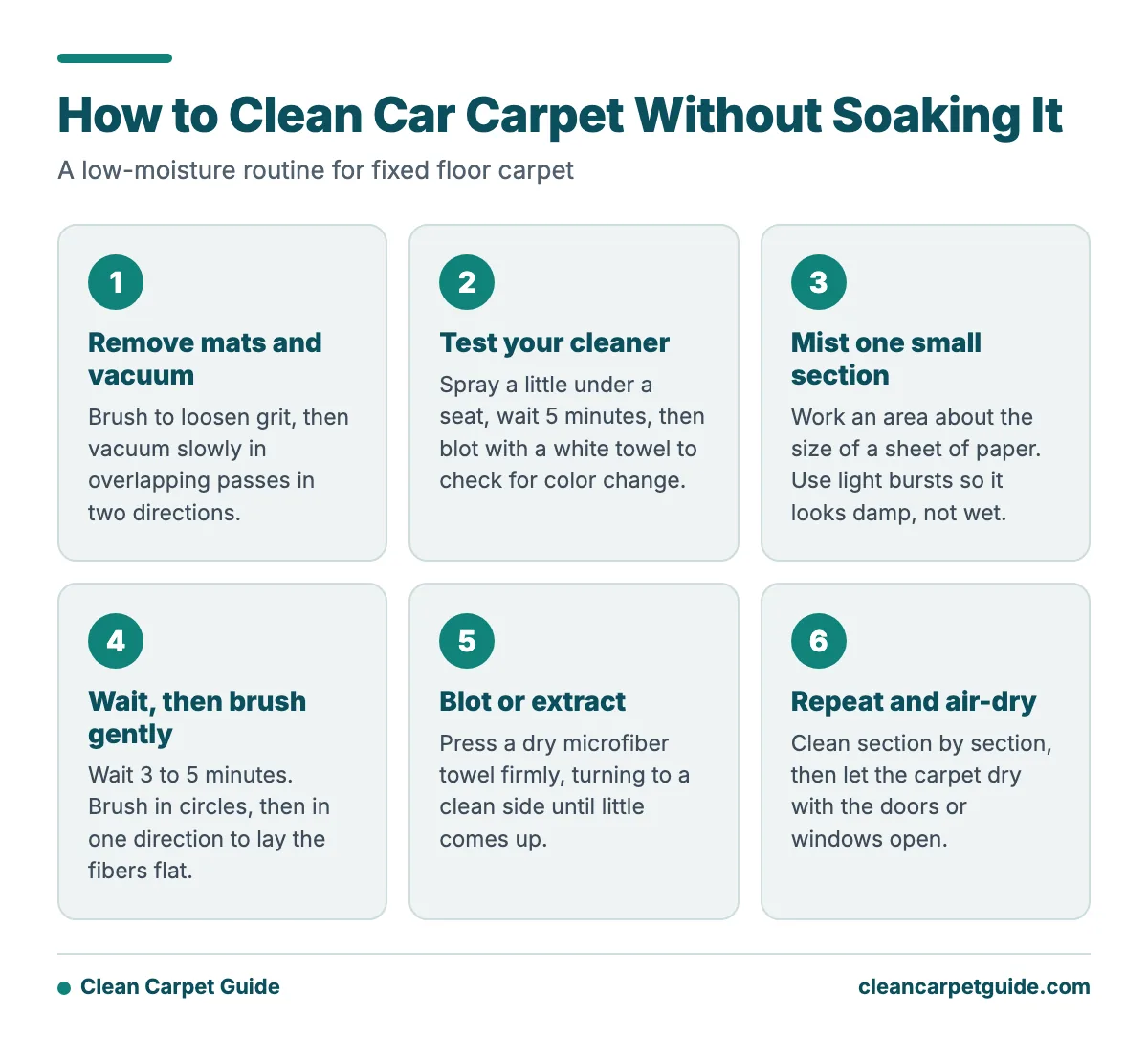
- Take out the floor mats. Set them aside to clean separately.
- Loosen the dirt. Brush the carpet in short strokes to lift sand and grit.
- Vacuum slowly. Make slow, overlapping passes in two directions. Fast passes leave grit behind, and grit acts like sandpaper on fibers.
- Test your cleaner. Spray a little under a seat, wait 5 minutes, then blot with a white towel. If color comes off or the spot looks different, stop.
- Mist one small section. Work an area about the size of a sheet of paper. Use light bursts so the surface looks damp, not wet.
- Wait 3 to 5 minutes. Or follow the time on the label. Do not let the cleaner dry on the carpet.
- Brush gently. Work in circles, then in one direction to lay the fibers flat.
- Blot or extract. Press a dry microfiber towel firmly into the carpet. Turn it to a clean side and repeat until little comes up.
- Move on and repeat. Clean section by section, then let the area air-dry with the doors or windows open.

What is the best way to clean carpet in a car without soaking it?
Put the cleaner on the brush or towel, not the carpet. For light spots, spray the cleaner onto a microfiber towel, work it into the stain and blot. Very little liquid reaches the padding underneath this way. This padding is often foam or felt that helps quiet road noise, and it holds water for a long time.
How do you deep clean car carpet and remove old stains?
Deep cleaning uses the same steps as routine cleaning, plus controlled extraction: a short spray pass followed by several suction-only passes. Suction matters more than spray. Weak suction leaves water in the backing, the slow drying that follows can cause mildew, and many guides skip this point.
Can you use a carpet cleaner or extractor inside a car?
Yes, a small portable spot cleaner or a wet/dry vacuum works well inside a car. A full-size household carpet machine usually does not. Small units fit into footwells and around seat rails. Big machines can put down more water than they can pull back up in tight spaces. Check that your machine’s manual approves it for automotive use.
Worked example
Take one front driver’s footwell. Assume about 5 square feet of carpet. The exact size varies by car, so measure yours if you want.
Cleaner amount: As a starting point, plan on about half a fluid ounce of mixed cleaner per square foot. 5 sq ft × 0.5 oz = about 2.5 fluid ounces. To check your sprayer, pull the trigger 10 times into a measuring cup and see how much comes out.
Tool order: brush dry → vacuum in two directions → mist one half of the footwell → wait 3 to 5 minutes → brush → 1 wet pass with the extractor → 3 suction-only passes → repeat on the other half → blot seams with a towel.
Drying setup: Leave the door and the opposite window open. Point a box fan at the footwell. Check after a few hours by pressing a dry paper towel into the carpet. If it picks up moisture, keep drying.
Cleaning one footwell at a time keeps the total water low. It also lets you stop early if a test patch shows a problem.
How do you clean carpet car mats?
Take carpet mats out of the car and clean them outside. You can rinse and dry them far better there than inside the cabin. This floor mat cleaning guide makes the same point about removable mats.
- Shake and beat the mat. Hit it against a wall or post to knock out grit.
- Vacuum both sides.
- Spray a bleach-free automotive carpet cleaner. Follow the mat label first. Some mats call for mild soap and water only.
- Leave it for 5 minutes, then scrub with a soft brush.
- Rinse lightly with a hose on a gentle setting, or with a bucket of clean water.
- Extract or squeeze out water. Use a wet/dry vacuum, or roll the mat in a towel and press.
- Hang the mat to dry. Hang it upright or over a rail, out of harsh direct sun if the backing is rubber.
Rubber mats are simpler. Hose them off, scrub with mild soap, rinse and wipe dry. Do not use shiny dressings on them, because a slick mat can slide under the pedals.
How do you remove mud, grease, coffee and other stains?
Each stain type needs a different first step, so name the stain before you choose a product. Always test the cleaner in a hidden spot first and blot with a white towel to check for color transfer.
| Stain | Safest first treatment | Avoid |
|---|---|---|
| Mud | Let it dry fully, break it up with a brush, vacuum, then treat any mark with carpet cleaner | Wiping wet mud, which spreads it deeper |
| Grease or oil | Cover with cornstarch or baking soda for 15 to 20 minutes, vacuum, then use a degreasing automotive spot cleaner | Hot water alone; heavy scrubbing |
| Coffee or soda | Blot right away, dab with cool water, then use carpet cleaner and blot again | Hot water, which can set sugars and tannins |
| Food | Scrape off solids with a dull edge, then use cleaner and blot | Rubbing, which pushes food into fibers |
| Vomit | Scrape, blot, then apply enzyme cleaner and leave for the label time (often 10 to 15 minutes) | Hot water and heat, which set proteins |
| Pet urine | Blot, apply enzyme cleaner, let it work as directed, blot and extract | Ammonia cleaners (they smell like urine to pets); bleach |
| Road salt | Vacuum, then dab with a mix of equal parts warm water and white vinegar, then blot with plain water | Using vinegar with bleach or any other cleaner |
How do you clean car carpet and seats without damaging upholstery?
Clean seats with far less liquid than carpet, and never spray straight into the cushion. Seat foam is thick and slow to dry. Many seats also hold heaters, airbags or weight sensors, so follow the owner’s manual.
- Vacuum the seat, including the seams and the gap between the seat and backrest.
- Check the care tag or codes. A seat cover marked X is vacuum-only. One marked S needs a solvent cleaner, not water.
- Spray cleaner onto a microfiber towel or soft brush, not the seat.
- Work one panel at a time, brushing gently.
- Wait 2 to 3 minutes, then blot with a clean, damp towel to lift the cleaner.
- Blot again with a dry towel, then leave the doors open to dry.
For vinyl, wipe with a damp microfiber and a mild interior cleaner. For leather, use a cleaner made for leather, then a conditioner. Carpet shampoo can dry leather out and leave it stiff.
How do you remove odors and pet hair?
Find and clean the source of an odor. Air fresheners only hide it. For pet hair, a rubber tool works better than a vacuum alone.
Odors
- Find the source. Check under seats, under mats and in seat rails.
- Clean any stain with the right product from the table above.
- Sprinkle a thin layer of baking soda over dry carpet. Leave it for at least 30 minutes, or overnight if the car can sit.
- Vacuum it up slowly.
- If the smell is musty, the padding may be damp. Dry the car fully before you do anything else.
Pet hair
Drag a rubber glove, rubber squeegee or pet-hair stone across the carpet in short strokes. The hair balls up so the vacuum can catch it. Lint rollers work on seats. Vacuum after each pass.

Keep pets and children out of the car until every treated area is dry. Ventilate while you work, especially with sprays, and keep the doors open.
How long does car carpet take to dry?
Lightly cleaned fixed carpet often dries in a few hours with good airflow. Washed carpet mats take much longer. One published maintenance guide recommends letting carpet mats air-dry for at least 24 hours when conditions allow. Rubber mats usually dry in under an hour once wiped.
- Airflow: Open the doors or windows on both sides so air moves across the car.
- Fan: A box fan aimed at the footwell speeds drying a lot.
- Dehumidifier: In damp weather, run a small dehumidifier inside the closed car.
- Heat: Running the car heater with windows cracked helps, but never leave a running car in a closed garage.
How to check: Press a dry paper towel firmly into the carpet, especially near seams and under the pedals. Also feel the back of each mat. If either feels cool or damp, wait longer. Damp mats on damp carpet trap moisture, and that is how mildew starts.
When should you call a professional?
Some jobs are not safe to do yourself. Call a professional detailer or restoration shop when:
- If the car took in flood water: Call a pro. Flood water can carry sewage and bacteria, and the padding usually has to come out. Electronics under the carpet may also be wet.
- If you see black mold or fuzzy growth: Call a pro. Do not scrub it, because that can spread spores.
- If a musty smell returns after drying: The padding is likely still wet. A detailer can lift the carpet or use stronger extraction.
- If the car is a classic or has original or rare interior materials: Get a specialist. Replacement carpet and fabric can be hard to match.
- If the stain is small and fresh: Handle it yourself with the steps above.
Frequently Asked Questions
What is the best way to clean carpet in a car?
Vacuum first, then mist a vehicle-safe carpet cleaner on small sections, brush gently and extract or blot the moisture back out. Clean removable mats outside the car. Let everything dry fully before you put the mats back.
How do you clean carpet car mats?
Take them out, shake and vacuum both sides, and apply a bleach-free automotive carpet cleaner. Leave it for about 5 minutes, then scrub, rinse lightly and extract the water. Hang them to dry for at least 24 hours. Follow the mat’s own care label if it has one.
How do you clean carpet on the car floor?
Work in small sections and use very little liquid. Fixed floor carpet sits on padding that holds water. Spray lightly, brush, and finish with several suction-only passes or firm blotting.
How do you deep clean car carpet?
Use a portable spot extractor or wet/dry vacuum. Do one light spray pass, then two or three suction-only passes per section. Treat old stains first with the right product, such as an enzyme cleaner for organic stains or an absorbent powder for grease.
What should you use when cleaning car carpet and seats?
Use a bleach-free cleaner labeled for automotive carpet and upholstery. Spray it onto a towel for seats, not directly onto the cushion. Check seat cover codes (W, S, W/S, X) and the owner’s manual, and test on a hidden spot first.
Can you use a household carpet cleaner inside a car?
A small portable spot cleaner usually works. A full-size upright machine is a poor fit, because it is hard to move in a footwell and can over-wet the backing. Check that the machine’s manual allows automotive use.
Sources
