
Homeowners and renters with a fresh spill on nylon or polyester carpet can try diluted distilled white vinegar first, because it may lift some water-based stains, rinse out soapy residue and calm mild odors. It is not a universal carpet cleaner, though. It can fade or damage wool, silk, unstable dyes and some backings. Below you will find a careful recipe, numbered steps, a stain-by-stain table and clear signs that it is time to use a commercial product or call a pro.
Quick answer
Use vinegar only on synthetic carpet, only diluted (start with 1/4 cup distilled white vinegar in 1 cup water), and only after a hidden-spot test and a check of the care instructions. Blot, rinse and dry fast. Never mix it with bleach.
- Best for fresh spills or soap residue on synthetic carpet: diluted white vinegar.
- Best for grease, protein or pet stains: an enzyme or fiber-specific commercial cleaner.
- Best for wool, antiques, flood water or mold: a professional.
- Use only distilled white vinegar, which is about 5% acid. Skip apple cider vinegar and strong “cleaning” vinegar.
- A gentle starting mix is 1/4 cup vinegar to 1 cup water. That comes to about 1% acid.
- Vinegar can help with fresh, water-based spots and detergent residue. It does a poor job on grease, protein stains and old stains.
- Vinegar does not remove the source of pet odors that have soaked into the pad.
- Never mix vinegar with bleach, because the mix can release chlorine gas.
- Use as little liquid as you can, then blot, rinse and dry quickly to protect the padding.
- Does vinegar clean carpet?
- Can I use apple cider vinegar as a carpet cleaner?
- What is the best white vinegar carpet cleaner recipe?
- How should I apply vinegar without damaging the padding?
- Does vinegar clean carpet stains?
- Which fibers and stains should not get vinegar?
- Does vinegar work in a carpet-cleaning machine?
- Dangerous combinations and common mistakes
- Vinegar vs. commercial cleaners vs. professionals
- When should you hire a professional?
- What do owners say?
- Frequently Asked Questions
Does vinegar clean carpet?
Vinegar cleans some messes on carpet. It does not clean the whole carpet. Household distilled white vinegar is about 5% acetic acid, which is the sour acid that gives vinegar its bite. That mild acid is good at a few specific jobs.
Where it can help:
- Detergent residue. Soaps and carpet shampoos are alkaline, meaning they sit on the high end of the pH scale. Leftover soap makes carpet feel sticky and get dirty again faster. A weak acid rinse helps loosen it.
- Fresh, water-based spills. Some sodas, drinks and muddy water may lift out if you treat them right away.
- Mild surface odors. Vinegar may neutralize some odor residue near the top of the pile.
Where it falls short: grease and oil, protein stains like blood, milk or vomit, dye stains, and anything old or set in.
Removing a stain is not the same as removing an odor source. If pet urine has soaked through to the padding, vinegar may hide the smell for a day. The smell often comes back on humid days because the source is still there. That job calls for an enzyme cleaner, which uses natural proteins to break down the waste. Sometimes it calls for new padding.
Can I use apple cider vinegar as a carpet cleaner?
Skip it and use distilled white vinegar instead. Apple cider, balsamic, red wine and malt vinegars all have color. They can also leave behind residue that stains or attracts dirt. Clear distilled white vinegar is the only household type that makes sense for carpet. The guide Use White Vinegar to Clean Carpets gives the same advice.
Watch out for stronger products too. Bottles sold as “cleaning” or industrial vinegar can be 20% acid or more. That is at least four times stronger than household vinegar, and it is far too harsh for carpet.
| Vinegar type | Acid strength | Use on carpet? |
|---|---|---|
| Distilled white vinegar | About 5% | Yes, diluted, if the carpet maker allows it |
| Cleaning or industrial vinegar | Can be 20% or more | No. It is too aggressive. |
| Apple cider, balsamic, red wine, malt | Varies | No. These can add color or residue. |
What is the best white vinegar carpet cleaner recipe?
The safest recipe is a weak one. Many online recipes call for equal parts vinegar and water, or even straight vinegar. Stronger acid raises the risk of fading and of damage to fibers and backing. It adds little cleaning power on a small spot.
Cautious spot recipe:
- Pour 1 cup (8 fl oz) of cool water into a clean spray bottle.
- Add 1/4 cup (2 fl oz) of distilled white vinegar.
- Cap the bottle, shake it, and label it “vinegar + water.” Do not add any other cleaner.
Worked example
A renter wants to treat a fresh soda spot on a polyester rug. The mix is 2 fl oz of vinegar plus 8 fl oz of water, which makes 10 fl oz in total.
Acid in the mix: 2 fl oz × 5% = 0.1 fl oz of acetic acid. Divide 0.1 by 10 fl oz and you get about 1% acid.
Compare that with other common ratios:
- 1 part vinegar to 3 parts water: 5% ÷ 4 = about 1.25%
- Equal parts: 5% ÷ 2 = 2.5%, which is 2.5 times stronger than this recipe
- 1 part vinegar to 10 parts water, used as a rinse for soap residue: 5% ÷ 11 = about 0.45%
The 10 fl oz batch is plenty for several small spots. To redo the math with your own numbers, multiply the ounces of vinegar by 0.05, then divide by the total ounces of liquid.
Some guides suggest a 1-to-3 ratio for spots. The 1/4-cup recipe is a little gentler, and that makes it a sensible place to start. Use it only after a patch test and only if your carpet maker’s care instructions allow mild acids.

How should I apply vinegar to carpet without damaging the backing or padding?
Use very little liquid and dry the spot fast. Too much moisture can soak into the padding and backing, where it dries slowly and can lead to odors or mold. Follow these steps:
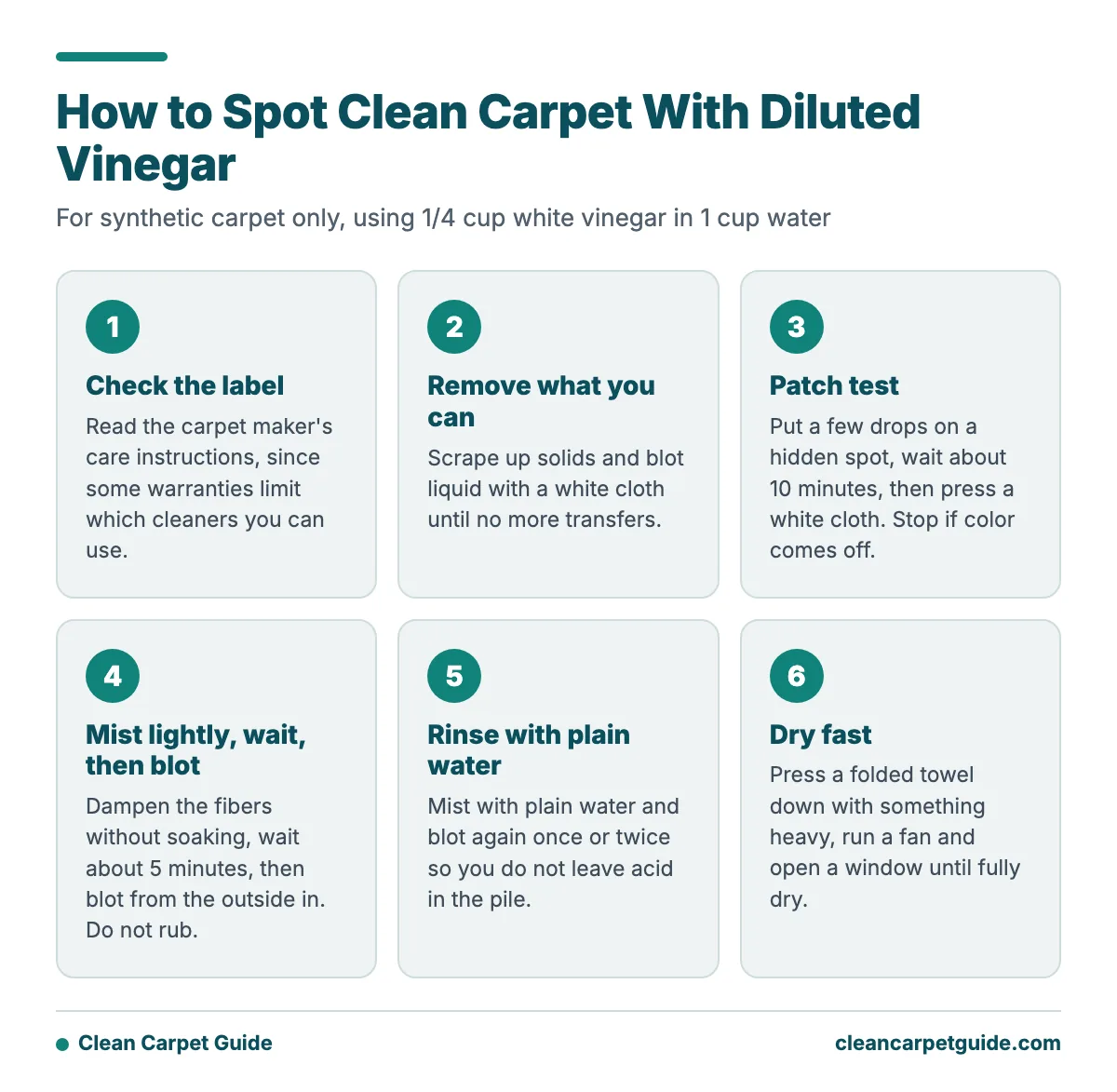
- Check the label. Read the carpet maker’s care instructions, since some warranties limit which cleaners you can use. On upholstery, check the cleaning code. W means water-based cleaners are fine. S means solvent only, so no vinegar. W/S means either type is fine. X means vacuum only.
- Remove what you can. Scrape up solids. Blot liquid with a white cloth until no more transfers. Vacuum the area once it is dry.
- Patch test. Put a few drops of the mix on a hidden spot, such as inside a closet or under a sofa. Wait about 10 minutes, then press a white cloth on it. If any color comes off, or if the spot looks lighter once dry, stop.
- Mist lightly. Spray just enough to dampen the stained fibers. Do not soak them. For tiny spots, dampen the cloth instead of the carpet.
- Wait, then blot. Leave the mix for about 5 minutes. Blot from the outside of the stain toward the middle. Do not rub, because rubbing spreads the stain and frays the fiber tips.
- Rinse. Mist the spot with plain water and blot again. Do this once or twice so you do not leave acid in the pile.
- Dry. Lay a folded dry towel on the spot and press it down with something heavy. Run a fan and open a window, since airflow speeds drying and clears the sour smell. Keep pets and children off the area until it is completely dry.
Does vinegar clean carpet stains?
Vinegar cleans some fresh stains on synthetic carpet and fails on many others. Use this table to decide before you spray.
| Stain | Carpet fiber | Vinegar? | Dilution | Safer choice |
|---|---|---|---|---|
| Fresh soda or black coffee | Nylon, polyester, olefin | Maybe | 1/4 cup to 1 cup water | Spot cleaner labeled for your fiber |
| Sticky soap or shampoo residue | Nylon, polyester, olefin | Yes, as a rinse | About 1 to 10 | Plain water rinse with extraction |
| Mild surface odor | Synthetic | Maybe | 1/4 cup to 1 cup water, light mist | Baking soda on dry carpet, then vacuum |
| Fresh pet urine | Synthetic | Short-term only | 1/4 cup to 1 cup water, after blotting | Enzyme cleaner made for pet urine |
| Old urine in the padding | Any | No | , | Professional extraction or new padding |
| Grease, oil, makeup | Any | No | , | Solvent spot remover, used as labeled |
| Blood, milk, egg, vomit | Any | No | , | Enzyme cleaner and cold water |
| Red wine or dye | Synthetic | Rarely works | , | Commercial stain remover, or a pro for large spots |
| Any stain | Wool, silk, jute, sisal, unknown dyes | No | , | Cleaner labeled safe for that fiber, or a professional |
Can vinegar remove old or set-in carpet stains?
Usually not. Old stains have bonded to the fiber or changed chemically over time. Each extra round of vinegar adds more acid and more moisture without much gain. Try one careful round at most. If the stain does not lighten, move to a commercial product made for that stain type, or call a professional.
Which carpet fibers and stains should not be treated with vinegar?
Keep vinegar off these carpets entirely:
- Wool and silk. Acids can discolor or weaken these animal fibers.
- Plant fibers such as jute, sisal, seagrass and cotton. These can brown or stain when they get wet.
- Unstable dyes. This includes hand-dyed rugs, many imported area rugs and any rug that bleeds color in a patch test.
- Delicate backings and finishes. Jute backings and some factory stain-resistant treatments may react badly. Check with the manufacturer first.
The article Vinegar on Carpet: What It Fixes and What It Ruins lists similar risks. If you do not know what your carpet is made of, treat it as delicate until you find out.
Does vinegar work in a carpet-cleaning machine?
Only use vinegar in a machine if the owner’s manual allows it. Some makers tell you to use only their own formula and warn that other solutions may affect the warranty. Read the manual before you pour anything into the tank.
If your manual does allow it, use vinegar as a rinse pass, not as the main cleaner:
- Clean with the machine’s approved formula first.
- Empty the tank and rinse it out.
- Fill the clean-water tank with a weak mix of about 1 part vinegar to 10 parts water.
- Make one wet pass. Then make two or three dry passes, with the trigger released, to pull the water back up.
- Empty and rinse both tanks when you finish.
Do not mix vinegar and machine detergent in the same tank. The acid cancels out the alkaline soap, so neither one works well.
What should you never mix with vinegar?
Never mix vinegar with bleach. The combination can release chlorine gas, which harms your lungs. Do not use the two one after the other on the same spot, either. Also keep vinegar away from hydrogen peroxide in the same container, because together they form a corrosive acid. The simplest rule is to use vinegar and water and nothing else in the bottle. The guide How To Use Vinegar For Carpet Cleaning Safely also warns against the bleach mix.
Common DIY mistakes: using vinegar undiluted or at equal parts, buying high-strength cleaning vinegar, using colored vinegar, soaking the spot, scrubbing hard, skipping the water rinse, and treating wool.
Stop-use checklist. Stop and switch methods if you see any of these:
- If color shows on your white cloth, the dye is unstable. Stop now.
- If the spot looks lighter or has a ring after drying, the acid faded the fiber. Do not repeat.
- If the area feels tacky once dry, residue is left. Rinse with plain water and blot.
- If it still smells sour after it is fully dry, you used too much. Rinse, blot and ventilate.
- If the carpet feels squishy or wet deep down, the pad is soaked. Press out water and run fans now.
- If you see backing, loose fibers or curling edges, the carpet is damaged. Call a professional.
Vinegar vs. commercial cleaners vs. professional extraction
For most fresh spills on synthetic carpet, try vinegar once. If that fails, switch to a commercial cleaner made for your fiber and stain type. Save professional cleaning for big, old or risky jobs.
| Factor | DIY vinegar | Commercial cleaner | Professional extraction |
|---|---|---|---|
| Stain severity | Small, fresh, water-based | Fresh to moderate, matched to stain type | Large, old, deep or repeated |
| Material risk | High on wool, silk and natural fibers | Lower if labeled for your fiber | Lowest; pros identify the fiber first |
| Equipment | Spray bottle, white cloths, fan | Spray bottle or home carpet machine | Truck-mounted or portable extractor |
| Drying time | Fast if applied lightly | Depends on product and amount | Strong suction removes more water |
| Likely result | Lightens some fresh spots | Better on grease, protein and pet stains | Best chance on tough stains and odors |
| Cost | Lowest; uses supplies you may already have | Moderate | Highest |
When should you hire a professional carpet cleaner?
Call a professional whenever the risk to your health or your carpet is high. That includes these jobs:
- Flood water. Water from floods or sewage can carry germs, and the padding usually needs replacing.
- Black mold. Do not try to clean it yourself with vinegar.
- Valuable, antique or hand-made rugs. One mistake can cause damage that cannot be undone.
- Wool or silk carpet with any stain that blotting and plain water won’t remove.
- Pet odors that keep coming back, since these usually mean urine has reached the padding.

What do owners say?
Owners like
- It costs very little and is easy to find
- It is simple to mix with things already in the kitchen
- It helps with some fresh spots and light surface smells
- There is less worry about added fragrance than with some store-bought cleaners
Common complaints
- A sour vinegar smell lingers while the carpet dries
- It does little for old, greasy, protein-based or deep stains
- It can discolor or damage the wrong fibers or dyes
- Using too much leaves the carpet wet and slow to dry
- Smells come back because the source is still there
Summarised from owner reviews and long-term user reports; individual experiences vary.
Frequently Asked Questions
How do I make vinegar carpet cleaner?
Mix 1/4 cup of distilled white vinegar with 1 cup of cool water in a clean, labeled spray bottle. That makes a mix of about 1% acid. Patch test it on a hidden spot first. Add nothing else to the bottle.
Can vinegar clean carpet stains?
Sometimes. It works best on fresh, water-based spills and soap residue on synthetic carpet. It does not do well on grease, blood, dye or old stains, so use a cleaner made for those instead.
Will vinegar clean carpet?
Vinegar can clean small spots, and it can work as a rinse to remove soap left behind by other cleaners. It is not a replacement for a full carpet cleaning, and it should not be used on wool or natural fibers.
Does an apple cider vinegar carpet cleaner work?
Use white vinegar instead. Apple cider vinegar has color and can leave residue that stains or attracts dirt. Distilled white vinegar is clear and is the right choice when vinegar is allowed.
Does vinegar work in carpet cleaner machines?
Only if the owner’s manual allows it. When it does, use about 1 part vinegar to 10 parts water as a rinse pass after the regular formula. Follow it with several dry passes so the carpet does not stay wet.
Sources
