
The most common mistake with this home remedy is pouring straight vinegar on a stain and scrubbing hard. Instead, mix distilled white vinegar with cool water, dab a little on a spot you have tested first, then blot, rinse and dry. This can help with fresh, water-based spills, mild odors and leftover soap on synthetic carpet, but it is not a cure-all, and it can harm wool, natural fibers and carpet-cleaning machines.
Quick answer
Diluted distilled white vinegar is fine to try on tested synthetic carpet (nylon, polyester, olefin) for fresh water-based spills, light odors and detergent residue. Start with about 1 part vinegar to 3 or 4 parts cool water. Apply a little, blot, rinse and dry fully. Skip it on wool, silk, sisal, jute, antique or unknown rugs. Never put it in a carpet-cleaning machine unless the maker allows it.
- Use vinegar only to treat spots. It is not meant for cleaning a whole room.
- Start with 1/4 cup distilled white vinegar in 1 cup cool water. Your carpet maker’s instructions come first.
- Test a hidden spot first. Stop right away if color comes off on your cloth.
- Never mix vinegar with bleach, ammonia or other cleaners.
- Mixing vinegar and baking soda makes both weaker and can leave powder in the carpet.
- Keep vinegar out of carpet-cleaning machines. Bissell warns it can permanently damage them.
- Can you clean carpet with vinegar?
- Is vinegar safe on synthetic, wool, or natural-fiber carpet?
- What should you check before using vinegar?
- How do you clean carpet with vinegar and water?
- Does vinegar clean carpet stains?
- Can you clean carpet with vinegar and baking soda?
- Can you put vinegar in a carpet-cleaning machine?
- When should you stop and call a professional?
- Frequently Asked Questions
Can you clean carpet with vinegar?
You can, but only for a few jobs and only on the right carpet. Vinegar is a mild acid, which means it can break down alkaline (soapy) residue and some fresh spills. It is still a weak general cleaner.
Vinegar is good at three things:
- Fresh, water-based spills. Examples are soda, juice and tea that have not dried yet.
- Mild odors. It can freshen a musty smell on the surface of the carpet.
- Detergent residue. This is leftover shampoo that makes carpet feel sticky and get dirty again fast.
Vinegar will not reliably fix grease, dye stains, old set-in stains or urine that has soaked deep. Guides such as how to use vinegar as a carpet cleaner safely make the same point. Undiluted vinegar, or too much of it, can damage fibers, dyes, backing and stain-resistant finishes.
The bigger risk is using too much liquid. Under the fibers is the backing, the woven layer that holds the tufts in place. Under that is the pad, the foam cushion. Liquid that reaches the pad dries slowly, can smell musty and may pull the stain back up later.
Is vinegar safe on synthetic, wool, or natural-fiber carpet?
Vinegar is usually fine on tested synthetic carpet. It is risky on wool, silk and plant fibers. Most US wall-to-wall carpet is nylon, polyester or olefin. Olefin is also called polypropylene. Hand-knotted, vintage and natural-fiber rugs need more care.
To find your fiber, check the label on the back of a rug, your purchase receipt or the manufacturer’s spec sheet. Renters can ask the landlord. If you cannot confirm the fiber, treat the rug as unknown.
| Carpet material | Vinegar suitability | Starting dilution | Safer alternative |
|---|---|---|---|
| Nylon | Usually OK after a hidden-spot test | 1 part vinegar to 3-4 parts water | Spot cleaner approved by the carpet maker |
| Polyester | Usually OK after a hidden-spot test | 1 part vinegar to 3-4 parts water | Plain cool water first, then an approved spot cleaner |
| Olefin (polypropylene) | Usually OK after a hidden-spot test | 1 part vinegar to 3-4 parts water | Approved spot cleaner |
| Wool | Avoid unless the maker or a professional approves it | Do not experiment | A cleaner labeled safe for wool |
| Silk | Avoid | None | Professional rug cleaner |
| Sisal or jute | Avoid, because even water can brown or warp plant fibers | None | Dry blotting, then a professional |
| Antique, handmade or unknown | Avoid | None | Professional rug cleaner |
Many synthetic carpets have a factory stain-resistant treatment. Some warranties also say which cleaners you may use. Read the warranty before you treat a spot. Using an unapproved product could affect your coverage.

What should you check before using vinegar?
Work through this checklist before every spot. If any step fails, stop and do not use vinegar.
- Identify the fiber. If it is wool, silk, sisal, jute, antique or unknown, do not use vinegar.
- Read the care label and the manufacturer’s instructions. If they rule out acids or home mixes, follow them instead.
- Test a hidden area. If color comes off on a white cloth, stop.
- Plan to dampen, not soak. If the spot is already soaked through to the pad, do not add more liquid.
- Use vinegar and water only. Never mix vinegar with bleach, ammonia or any other cleaner.
- Stop if anything changes. If you see fading, a rough feel or a spreading ring, stop and call a professional.
Chlorine bleach must never be mixed with vinegar or ammonia. These combinations can release dangerous gases. Do not layer vinegar over a store-bought cleaner you just used. Rinse that cleaner out with plain water first.
If you are treating a sofa or chair, check its upholstery cleaning code. It is usually on a tag under the cushions:
- W means water-based cleaners are allowed.
- S means solvent cleaners only, so do not use vinegar and water.
- W/S means either type is allowed.
- X means vacuum only.
Open a window while you work. Keep pets and children off the area until it is fully dry.
How do you clean carpet with vinegar and water?
Mix a weak solution, apply a small amount, blot it out, rinse with plain water and dry the spot fully. Follow these steps:
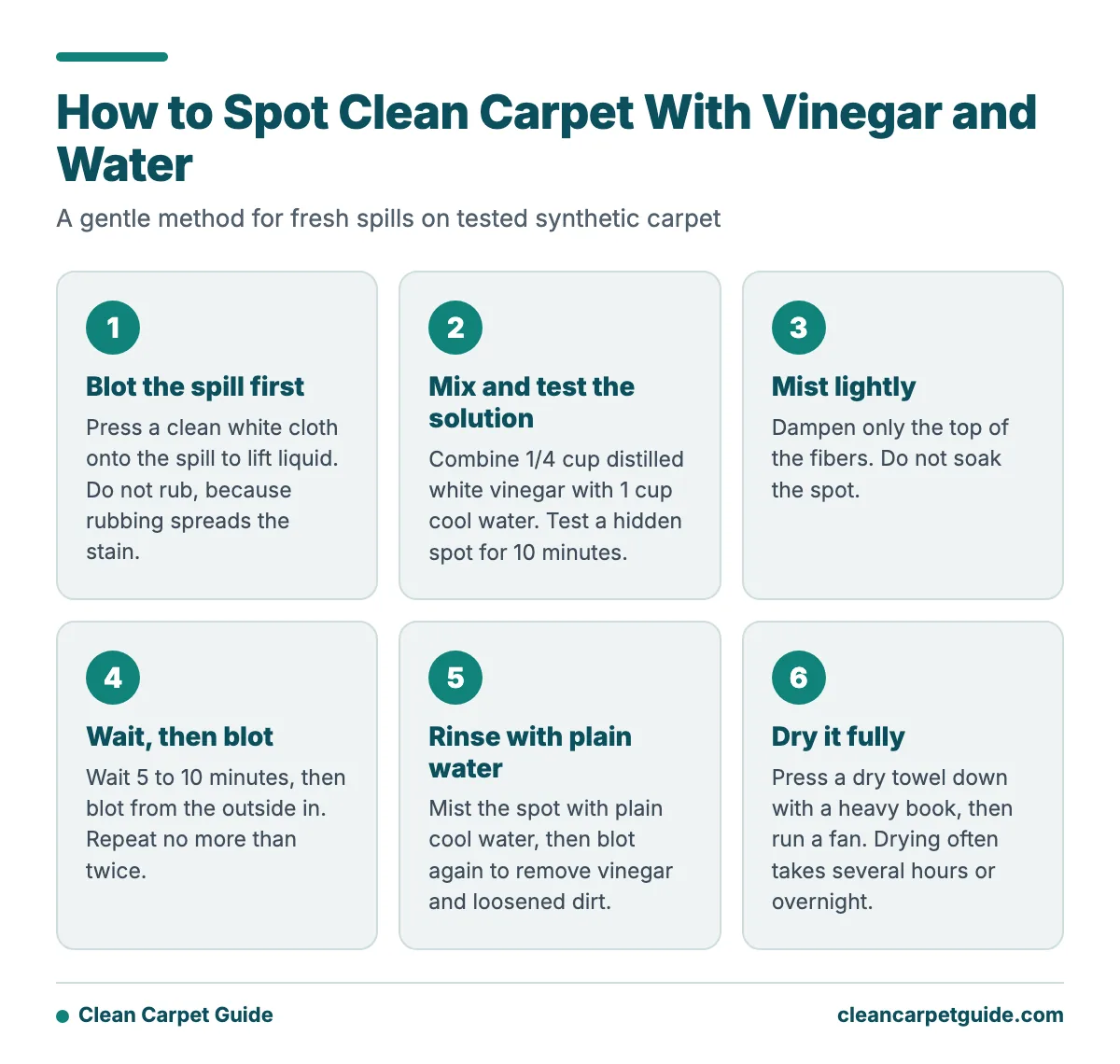
- Blot the spill first. Press a clean white cloth onto it to lift as much liquid as you can. Do not rub, because rubbing spreads the stain and frays fibers.
- Mix the solution. Pour 1/4 cup distilled white vinegar and 1 cup cool water into a clean spray bottle. Label the bottle.
- Test a hidden spot. Try it inside a closet or under a sofa. Mist the spot, wait 10 minutes, then press a white cloth on it. If color comes off, stop. Let the test spot dry and check it for fading or stiffness.
- Mist lightly. Dampen only the top of the fibers. Do not soak the spot.
- Wait 5 to 10 minutes. This gives the mix time to loosen the spill. Do not let it dry on the carpet.
- Blot from the outside in. Use a clean section of cloth each time. Repeat steps 4 to 6 no more than twice.
- Rinse. Mist the spot with plain cool water, then blot again. This removes vinegar and loosened dirt.
- Dry it fully. Lay a dry towel on the spot and press it down with a heavy book. Then run a fan and open a window. Drying often takes several hours or overnight. The vinegar smell fades as the spot dries.
You will see different ratios online. The brief’s sources suggest these: about 1 part vinegar to 3 parts water as a cautious start, 1 to 4 for a gentler mix, and about 1 to 10 for rinsing detergent residue. If your carpet maker gives different instructions, follow the maker.
Worked example
A renter wants to spot-clean a fresh juice spill on a nylon carpet. The mix is 1/4 cup (2 fl oz) of vinegar and 1 cup (8 fl oz) of water, which makes 10 fl oz in total.
That is a 1:4 ratio, so vinegar makes up 2 ÷ 10 = 20% of the bottle. Most US grocery-store white vinegar is labeled 5% acidity. So the spray is about 5% × 0.20 = 1% acid.
For a residue rinse at about 1:10, the renter would mix 2 tablespoons (1 fl oz) of vinegar with 10 fl oz of water. That works out to 5% × 1/11 ≈ 0.45% acid.
The renter mists the test area lightly, waits 10 minutes and blots. No color comes off, so they treat the spill, rinse it with plain water and dry it fully.
Does vinegar clean carpet stains?
It helps with some stains and does little for others. Use this table to decide:
| Stain type | Will vinegar help? | Better approach |
|---|---|---|
| Fresh water-based spill (soda, juice, tea) | May help | Blot first, then use a 1:3-1:4 mix and rinse |
| Alkaline detergent residue | Often helps | Use a weak 1:10 rinse, blot, then rinse with plain water |
| Grease or oil | Poor | Absorb with a dry cloth, then use a solvent spot cleaner the maker approves |
| Pet urine | Limited, surface only | Use an enzyme cleaner made for urine. Call a professional if it soaked into the pad |
| Dye (red drinks, ink, hair dye) | Unreliable, and it may spread the stain | Use a dye-specific remover or call a professional |
| Old, set-in stains | Unlikely | Professional cleaning |
Southern Living’s guide to cleaning carpet with vinegar also stresses blotting quickly and using a weak mix.
Can you clean carpet with vinegar and baking soda?
You can use both, but use them one at a time. Do not mix them. The fizz you see is an acid reacting with a base. The reaction cancels out much of what each one does and leaves water, a salt and gas. It looks strong, but the result is weaker than either ingredient alone. It can also leave white powder in the fibers that attracts dirt.
- Sprinkle a thin layer of dry baking soda on dry carpet to absorb odor.
- Leave it for at least 15 minutes. For stronger smells, leave it a few hours.
- Vacuum slowly, then vacuum a second time to get the powder out.
- If a spot still needs work, use the vinegar-and-water steps above. Rinse and dry fully afterward.

Can you put vinegar in a carpet-cleaning machine?
Do not, unless the machine’s manufacturer says you can. Bissell warns that vinegar can permanently damage carpet and floor-cleaning machines. Hoover, Shark and Rug Doctor guidance generally tells users to use their own approved formulas.
An unapproved liquid in the tank may also affect your warranty. That applies to rental machines too. For more detail, see this roundup of what carpet cleaner makers say about vinegar. To remove soap residue, use the maker’s rinse formula if it offers one, or rinse the spot by hand.
When should you stop and call a professional?
Stop treating the spot yourself and call a carpet or rug professional if:
- The carpet was soaked by flood water, which can carry sewage and bacteria.
- You see black mold or smell it under the carpet.
- The rug is wool, silk, antique, handmade or valuable.
- Color bleeds, fades or spreads during your test.
- Urine has soaked into the pad, or the odor keeps coming back.
- The stain is still there after two careful tries.
Frequently Asked Questions
Is vinegar good to clean carpet?
It is good for a few small jobs, but it is not a full carpet cleaner. Diluted vinegar can help with fresh water-based spills, light odors and soap residue on synthetic carpet. It does little for grease, dye or old stains.
Does white vinegar hurt carpet?
It can. Undiluted vinegar, or too much of it, can harm fibers, dyes, backing and stain-resistant finishes. This is most likely when the carpet gets soaked. Always dilute it, test a hidden spot first and use as little as possible.
Does vinegar and water remove odors and detergent residue?
It can lift mild surface odors and alkaline soap residue. A weak mix of about 1 part vinegar to 10 parts water works for residue. It will not remove odors that have soaked into the pad. Deep urine smells need an enzyme cleaner or a professional.
Is it ok to clean carpet with vinegar?
It is fine on tested nylon, polyester or olefin carpet when you use a diluted mix and follow the care label. Avoid it on wool, silk, sisal, jute and unknown rugs. Never mix it with bleach or ammonia. Keep pets and children away until the spot is dry.
Sources
