
Blotting one fresh spill by hand with diluted white vinegar is a very different job from pouring vinegar into a carpet-cleaning machine. The first can work for fresh, water-based spots and mild odors on colorfast synthetic carpet (carpet whose dye does not run when wet). The second is usually a bad idea unless your machine maker and your carpet’s care instructions both say vinegar is allowed. Below you will find the safe mix, a step-by-step method, the fibers and stains to avoid, and what to put in your machine instead.
Quick answer
Use diluted distilled white vinegar only by hand, on small fresh spots, on colorfast synthetic carpet. Keep it out of your carpet-cleaning machine unless the manual clearly allows it, because many makers require their own formulas.
- Best for a fresh, small spill: 1/4 cup vinegar in 1 cup cool water, blotted by hand.
- Best for whole-room cleaning: your machine with its approved formula.
- Best for wool, silk, antique rugs or flood damage: a professional cleaner.
- A weak starting mix is 1/4 cup distilled white vinegar plus 1 cup cool water, for hand-treating one small spot.
- Vinegar helps most with fresh, water-soluble spills and light surface odors. It does little for grease, protein stains or old marks.
- Do not put vinegar in a carpet-cleaning machine unless the manual says you can. Unapproved liquids may harm the machine or your warranty.
- Skip vinegar on wool, silk, jute, sisal, antique rugs and carpets with unstable dyes.
- Mixing vinegar with baking soda mostly cancels out both. Never mix vinegar with bleach.
- Always spot-test, blot instead of scrubbing, rinse with plain water and dry the area fully.
- Does vinegar and water clean carpet?
- What ratio of white vinegar to water should I use on carpet?
- How to spot-clean carpet with vinegar and water
- How should I spot-test vinegar carpet cleaner?
- Can I use vinegar water in my carpet-cleaning machine?
- What should I use instead of vinegar in a carpet-cleaning machine?
- Is vinegar safe for wool, silk, jute, sisal, and synthetic carpet?
- What types of stains can diluted vinegar help remove?
- Can I mix vinegar and baking soda on carpet?
- Printable safety checklist
- Common mistakes and when to call a professional
- What do owners say?
- Frequently Asked Questions
Does vinegar and water clean carpet?
Diluted vinegar can clean some carpet spots, but only a narrow group of them. It works best on fresh spills that dissolve in water, such as soda, juice or a muddy paw print, and on light odors sitting near the surface.
White vinegar is a mild acid. That helps it loosen some light, water-based marks. It is not soap, though. It does not break down grease well, and it is not a dependable fix for protein stains like blood, milk, egg or vomit.
Here is the short version:
- Can help: fresh soda, juice, tea or coffee drips caught quickly, light dirt marks, mild surface smells.
- Unlikely to help: cooking oil, butter, makeup, old stains, stains that have soaked into the pad, and odors whose source is still in the carpet.
For a closer look at the limits, see this guide on how to clean carpet with vinegar without damaging it.
What ratio of white vinegar to water should I use on carpet?
Start weak: 1/4 cup distilled white vinegar mixed with 1 cup cool water. This is a commonly cited starting point for spot treatment, and it is meant for one small spot that you treat by hand.
Use distilled white vinegar only. Apple cider vinegar and other colored vinegars can leave their own tint behind. Use cool water, too. Hot water can help some stains set.
Worked example
Picture a fresh orange juice spill about the size of a coaster on a beige nylon carpet.
- 1/4 cup vinegar = 2 fluid ounces
- 1 cup water = 8 fluid ounces
- Total mix = 10 fluid ounces
- Vinegar share = 2 ÷ 10 = 20% of the mix
Most US distilled white vinegar is labeled 5% acidity (check your bottle). So the acid in the final mix is about 5% × 0.20 = 1%. That is mild, which is the point.
Ten ounces is far more than one coaster-sized spot needs. The person cleaning would use a few sprays or dabs, not the whole bottle. This mix is for a small hand-treated spot. It is not a recipe to pour into a machine tank.
How to spot-clean carpet with vinegar and water
Follow these steps in order. The whole job usually takes 15 to 20 minutes, plus drying time.
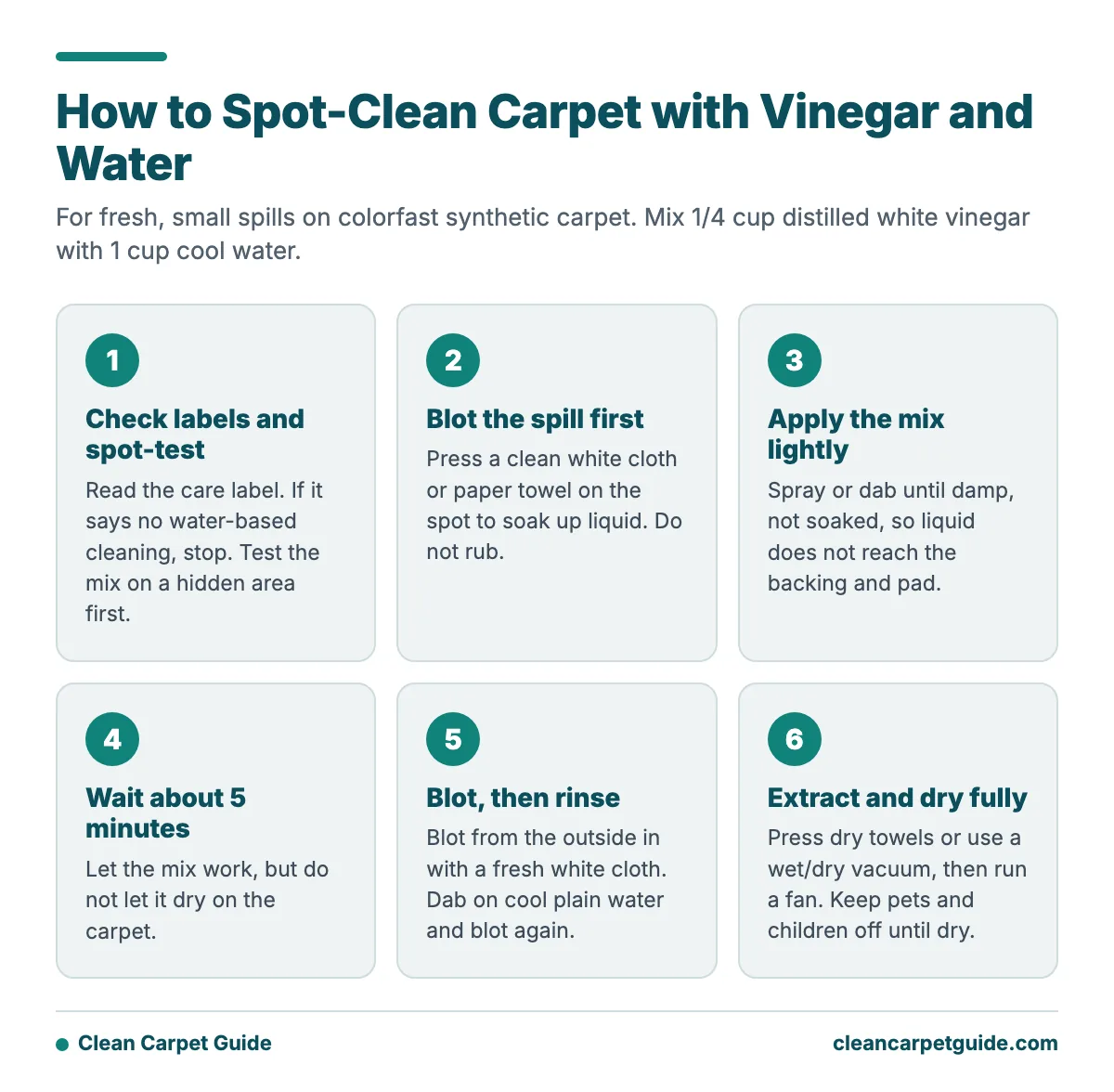
- Read the labels. Check the carpet or rug care label and any manufacturer instructions. If they say no water-based cleaning, stop here.
- Open a window or run a fan. Good airflow helps the smell fade and the spot dry.
- Blot the spill first. Press a clean white cloth or paper towel on the spot to soak up as much liquid as you can. Do not rub.
- Spot-test. Try the mix on a hidden area first (see the next section).
- Apply lightly. Spray or dab the mix onto the spot until it is damp, not soaked. Too much liquid can reach the backing (the base layer the fibers are attached to) and the pad below.
- Wait about 5 minutes. Do not let it dry on the carpet.
- Blot from the outside in. Use a fresh white cloth. Working toward the center keeps the stain from spreading. Never scrub, because scrubbing can fuzz and untwist the fibers.
- Rinse with plain water. Dab a little cool water on the spot, then blot again. This removes leftover vinegar and loosened dirt.
- Pull out the moisture. Press a thick stack of dry towels on the spot, or use a wet/dry vacuum. Repeat until the towels come up almost dry.
- Dry it fully. Point a fan at the area. Keep pets and children off it until it is completely dry, which can take several hours.

How should I spot-test vinegar carpet cleaner?
Test on a hidden spot before you touch anything visible. Inside a closet, under a sofa or beneath a rug corner all work well.
- Dab a small amount of the vinegar mix onto the hidden area.
- Wait about 10 minutes.
- Press a clean white cloth on the spot. Look for any dye on the cloth.
- Check the carpet for fading, darker patches or a change in texture.
- Let the spot dry fully, then check again. Some browning only shows up after drying.
If you see any color on the cloth or any change in the carpet, do not use vinegar on that carpet.
Can I use vinegar water in my carpet-cleaning machine?
Only if your machine’s manual clearly says you can. Many carpet-cleaner makers recommend their own formulas, and some warn that vinegar or other unapproved solutions can damage the machine or affect warranty coverage. This summary of what carpet-cleaner makers say about vinegar covers the warnings in more detail.
An upright carpet cleaner pumps liquid through hoses, seals and spray tips. Makers design those parts and their formulas to work together. A liquid they did not approve is a risk you take on yourself, and a warranty claim may be refused if the damage is linked to it.
A machine also wets a much larger area than hand cleaning. That raises every other risk: dye bleeding, overwetting, slow drying and a sour smell across the whole room.
If your manual does allow a vinegar rinse, some guidance uses about 1 part vinegar to 10 parts water. Here is the math for a 1-gallon tank:
- 1 gallon = 128 fluid ounces
- 1 + 10 = 11 parts in total
- 128 ÷ 11 = about 11.6 ounces per part
- So: about 11.6 ounces (just under 1 1/2 cups) of vinegar, then fill with cool water to the 1-gallon line
Do not add vinegar to a tank that already holds detergent unless the instructions say to. And never put bleach in the same tank, ever.
What should I use instead of vinegar in a carpet-cleaning machine?
Use the formula your machine’s maker approves, or another carpet detergent the manual lists as compatible. For most people, that is the right choice for whole-room cleaning.
| Factor | Diluted vinegar | Maker-approved carpet detergent |
|---|---|---|
| Stain performance | Fresh, water-based spots and light odors only | Designed for general soil; many are made for specific stains |
| Residue | Little, if rinsed well | Can leave residue if overused; follow the dose on the label |
| Machine compatibility | Often not approved by the maker | Made to work with the machine |
| Odor | Sour smell while drying | Usually scented; some unscented options exist |
| Warranty risk | May affect coverage if the maker forbids it | Lowest risk when used as directed |
Other good choices:
- Plain water rinse: only if your manual allows a water-only pass.
- Labeled spot cleaner: pick one made for the stain type, such as grease or pet and protein stains, and follow its dwell time.
- Professional cleaning: for set-in stains, delicate fibers or large problem areas.
Is vinegar safe for wool, silk, jute, sisal, and synthetic carpet?
Vinegar is lowest-risk on colorfast synthetic carpet and a poor choice for natural and delicate fibers. Wool, silk, sisal, jute, antique rugs and items with unstable dyes face higher risks of dye bleeding, browning, shrinking, warping, felting (fibers matting together) or other fiber damage.
| Material | Vinegar by hand? | Main risks |
|---|---|---|
| Nylon, polyester, olefin (synthetic) | Usually OK after a spot test | Dye bleeding if not colorfast; overwetting |
| Wool | Avoid unless the care label allows it | Dye bleeding, shrinking, felting |
| Silk | No | Color loss, fiber damage |
| Jute and sisal | No | Browning, shrinking, warping |
| Antique, valuable or hand-dyed rugs | No; call a professional | Dye bleeding, lasting damage |
Check the backing, too. Some rugs have jute or cotton backing that can brown or stay damp even when the top fibers are synthetic.
Cleaning a sofa or chair instead? Look for the cleaning code on the tag. W means water-based cleaners are allowed. S means solvent-only, so no vinegar. W/S means either type is allowed. X means vacuum only, with any wet cleaning done by a professional. More fiber tips are in this guide to using vinegar as a carpet cleaner safely.
What types of stains can diluted vinegar help remove?
Diluted vinegar is a reasonable first try for fresh, water-soluble stains on synthetic carpet. For grease, protein, old or deep stains, pick something else. Use this table to decide.
| Situation | Hand spot treatment with vinegar | Machine use | Professional |
|---|---|---|---|
| Fresh soda, juice or mud on synthetic carpet | Good first try | Approved formula for large areas | Rarely needed |
| Grease, oil or makeup | Poor results | Approved formula or labeled grease spot cleaner | If large or stubborn |
| Blood, milk, egg or vomit (protein) | Not dependable | Labeled protein or pet cleaner | If set in |
| Old or deep stains | Unlikely to work | May help with approved formula | Often the best option |
| Any stain on wool, silk, jute, sisal or antique rugs | Skip | Skip unless the care label allows it | Yes |
| Flood water or black mold | Skip | Skip | Yes, always |
Odor works the same way. Vinegar can soften a light surface smell. If the source, such as pet urine, has soaked into the pad, the smell will likely return.
Can I mix vinegar and baking soda on carpet?
You can, but it is not worth it. Vinegar is an acid and baking soda is a base. When they meet, they fizz and make carbon dioxide and water, and that reaction cancels out much of what each one does alone.
The bubbling looks like scrubbing power, but it is mostly gas. You end up with a damp spot and a powder residue to vacuum out.
If you want to use both, keep them separate. Sprinkle baking soda on a dry carpet for odor, let it sit for a few hours, then vacuum it up. Use vinegar on a different day for a fresh spill.
Printable safety checklist
Print this or save it to your phone. Run through it every time.
- ☐ Read the carpet care label and the machine manual.
- ☐ Identify the fiber: synthetic, wool, silk, jute, sisal or a blend.
- ☐ Check upholstery codes (W, S, W/S, X) if you are cleaning furniture.
- ☐ Open a window or run a fan.
- ☐ Patch-test on a hidden area and let it dry.
- ☐ Blot; do not scrub.
- ☐ Rinse with plain cool water.
- ☐ Extract moisture with towels or a wet/dry vacuum.
- ☐ Dry completely with airflow.
- ☐ Keep pets and children off until it is dry.
- ☐ Never mix vinegar with bleach.

Common mistakes and when to call a professional
Most vinegar problems come from using too much, on the wrong fiber, or on the wrong stain. Watch for these mistakes:
- Soaking the spot. Extra liquid slows drying and can cause wicking and musty smells.
- Scrubbing. It spreads the stain and roughs up the fibers.
- Skipping the rinse. Leftover vinegar keeps the sour smell around longer.
- Using it straight from the bottle. Full-strength vinegar raises the risk of color damage.
- Filling a machine tank with it. This can risk the machine and your warranty.
If the spill is fresh, small and on colorfast synthetic carpet, then try the 1/4 cup to 1 cup mix by hand.
If you are cleaning a whole room, then use your machine with its approved formula.
If the stain is greasy, protein-based or old, then use a cleaner labeled for that stain, or call a professional.
If the rug is wool, silk, jute, sisal, antique or valuable, then call a professional.
If the carpet got wet from flood water or shows black mold, then stop and call a professional. These are health and damage problems, not stains.
What do owners say?
Owners like
- It costs little and is easy to find in any store.
- It is simple to mix from things already in the kitchen.
- It helps with some fresh spots and light surface smells.
- It adds less fragrance than many store-bought cleaners.
Common complaints
- A sour vinegar smell can hang around while the carpet dries.
- It does little for old, greasy, protein-based or deep stains.
- It can discolor or damage fibers and dyes that are not suited to it.
- Using too much liquid leaves the carpet wet and slow to dry.
- Smells can come back if the source was never removed.
Summarised from owner reviews and long-term user reports; individual experiences vary.
Frequently Asked Questions
Can you clean carpet with vinegar and water?
You can clean some spots with it. Mix 1/4 cup distilled white vinegar with 1 cup cool water, test a hidden area, apply lightly, wait about 5 minutes, blot, rinse with plain water and dry fully. Keep it to colorfast synthetic carpet and fresh, water-based spills.
Is vinegar and water a good carpet cleaner?
It is a decent cheap first step for small, fresh spills, but not a good all-purpose carpet cleaner. It struggles with grease, protein stains and old marks, and it can harm wool, silk, jute and sisal.
Does vinegar and water clean carpet stains?
It can lift fresh, water-soluble stains like soda or juice. It is not dependable on old, greasy, protein-based or deeply set stains. For those, use a cleaner labeled for that stain type or call a professional.
Can you use vinegar and water in a carpet cleaner?
Only when your machine’s manual clearly allows it. Many makers require their own formulas and warn that unapproved solutions may damage the machine or affect the warranty. If vinegar is allowed, some guidance uses about 1 part vinegar to 10 parts water.
Why does my carpet smell like vinegar after cleaning?
The smell lingers until the carpet is fully dry. Rinse the spot with plain water, extract as much moisture as you can and run a fan. If an odor remains after drying, the original source may still be in the carpet or pad.
Sources
